Margaret is 78 and lives alone in a small terrace on the edge of Stoke-Sub-Hamdon, two streets away from our office. Her husband died in 2019. She has a daughter in Crewkerne who visits every Sunday and a son in Australia who telephones every other weekend. She does the Times crossword in pencil at the kitchen table and she does not, as a rule, watch television in the morning. She was admitted to Ward 6A on the morning of Monday 24 March 2025 for a left-hip arthroplasty that she had been on the waiting list for since the previous September.
The operation went well. By Tuesday morning she was sitting up in bed in some pain but in good humour. She had a book, a small overnight bag her daughter had packed for her, and her glasses. She did not have a radio because, as she said when I came by, “I forgot. I always have the wireless on at home. I forgot.”
The trolley
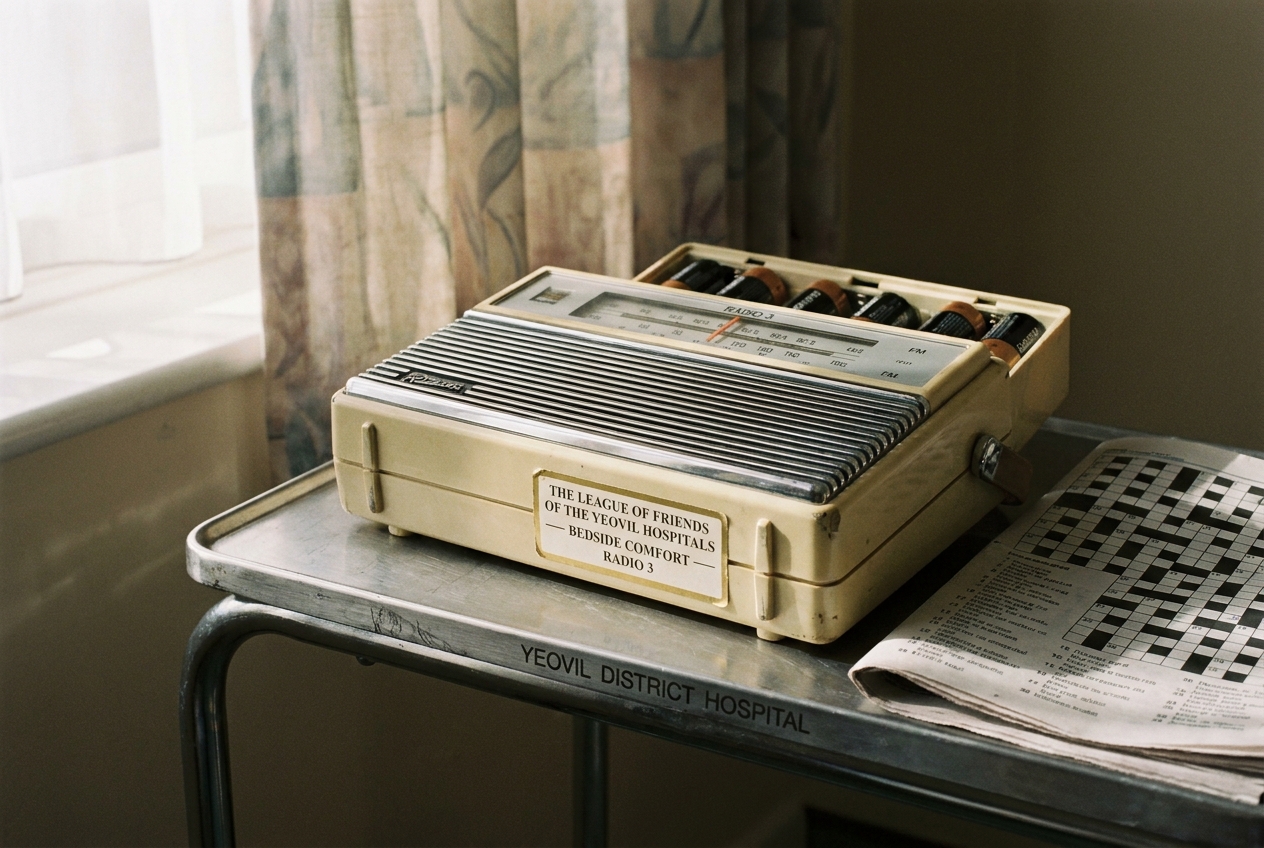
The trolley reached Ward 6A at 10.20 that Tuesday morning. We have two volunteers on a trolley round at any time, and the morning of 25 March 2025 was Linda and Gillian — both long-standing, both from the village of Martock. The trolley carries the usual range of newspapers, magazines, sweets, soft drinks, and toiletries; behind a small partition is the Comforts float, which holds the things we give away. The Comforts float at that time of year, as it does every Easter, held twelve small Roberts radios, each with a Friends’ sticker on the back and a set of batteries.
The radios are an old idea. We have given them away since 1986, when a Yeovil donor — a Mr Peter Hodder, since deceased — left us £1,200 in a small legacy and asked that it be spent on bedside radios for patients without one. We have honoured the legacy informally every year since. We buy them in bulk from a wholesaler in Bristol; we keep twelve at a time on the trolley; we restock the float from a small ring-fenced line in the budget. The radios are not new. They are a particular kind of small, no-nonsense, mains-or-battery Roberts that the wards prefer because they do not have screens and they do not need plugging into the wifi.
Linda asked Margaret if she would like one. Margaret said yes. Linda took a radio off the trolley, switched it on to test it, and handed it across the bed. The radio was already tuned. It had come from the wholesaler tuned to Radio 3 — that is to say, to the BBC’s classical-music station — and Linda had not retuned it before adding it to the float. Margaret listened for a moment and asked Linda to leave it on Radio 3. Linda did. The trolley carried on round.
I had not listened to Radio 3 since my husband was alive. I had forgotten how much I liked it. Margaret · 78 · Stoke-Sub-Hamdon, in a thank-you letter to the trustees
The week
Margaret kept the radio on Radio 3 for the next six days. She told the ward sister, who told the matron, who told the chair at the May trustees’ meeting. The Friends’ trolley came past Margaret’s bedside every morning between Tuesday and the following Sunday, and Linda — who is on the Tuesday and Friday rota — checked in on the radio each time. By Friday the batteries were getting tired and Linda swapped them out. By Saturday Margaret had recommended Radio 3 to the woman in the next bay, who had requested a radio of her own. By Sunday morning Margaret had her physiotherapy assessment and was discharged in the early afternoon.
The radio went home with her. It is the Friends’ policy that radios from the Comforts float are kept by the patient — there is no expectation that they will be returned. The cost to us, batteries included, is £19.40 per unit. Margaret’s radio is now in the kitchen of her terrace in Stoke-Sub-Hamdon, where it is, as I write, still tuned to Radio 3, and where she now listens to it every morning over breakfast.
The thank-you
Margaret wrote to the trustees from her sitting-room a fortnight later. She explained, in a single page, that she had not listened to Radio 3 since her husband had been alive — that he had been the one who put it on at breakfast every morning — and that she had not realised how much she had missed it. She wrote that the radio had “quietly mended a bit of me”. She included a £50 cheque for the Comforts float.
The cheque has paid for two further Roberts radios on this season’s float, each pre-tuned to Radio 3 in honour of the original. Linda’s trolley round handed one of them to a man on Ward 8A in the last week of January. He kept it on Radio 3 too.
The lesson, if there is one
We give away approximately seven hundred small comforts a year from the trolley float — radios, slippers, lavender bags, toothbrushes, magazines, charging cables. They cost the charity about £18,400 a year. Almost none of them are remembered in the way Margaret remembered her radio. Most are quietly used and forgotten. That is fine. The radios are not in the budget so that they will be remembered. They are in the budget so that someone, occasionally, will be reminded of something she did not know she was missing.
The Friends’ trolley will be on Ward 6A this morning at 09.30. There are twelve radios on the float. Most are pre-tuned to Radio 2. One, by quiet convention since March 2025, is tuned to Radio 3.